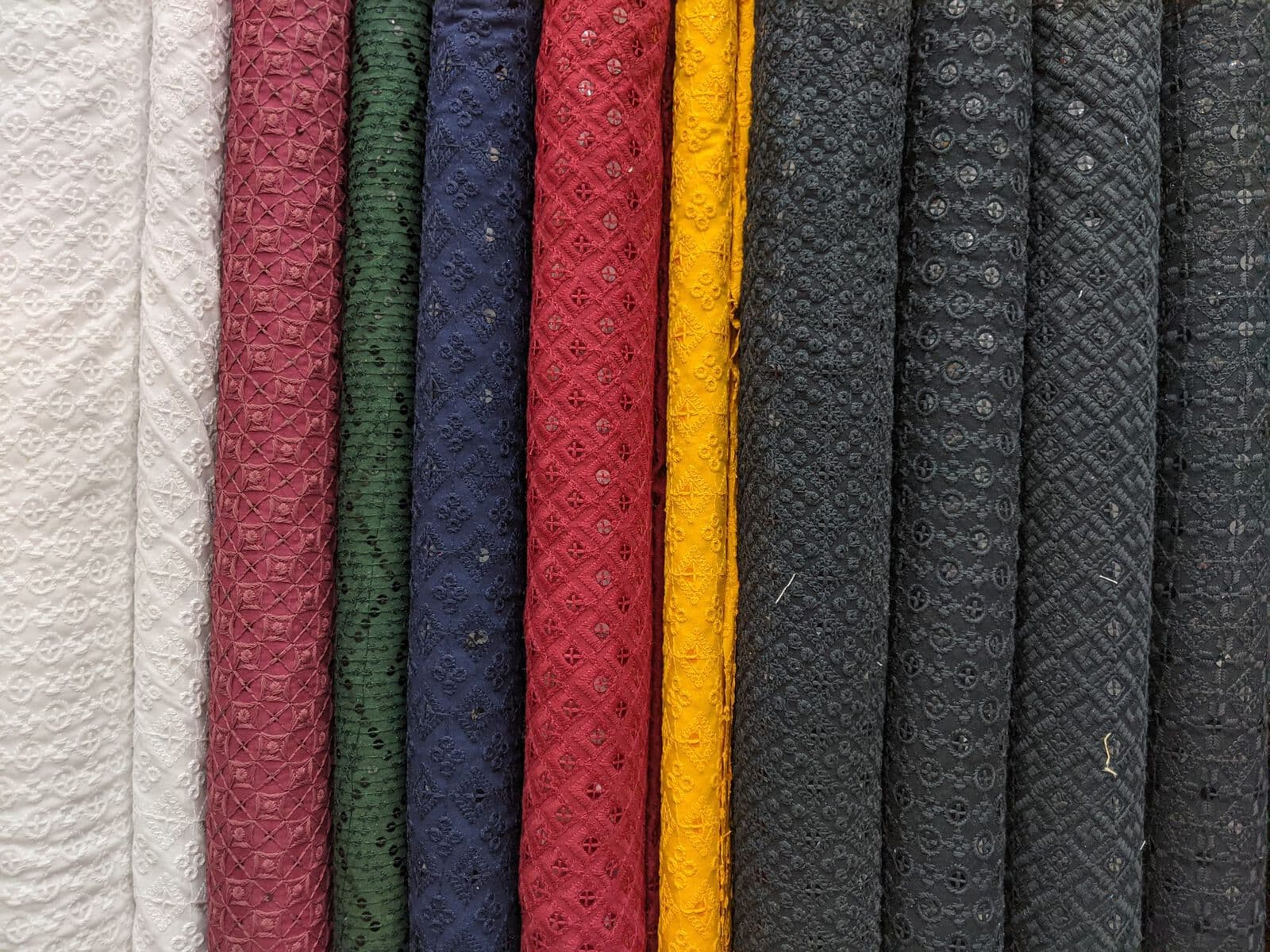
Fabric decides most of what a garment costs, how it looks after repeated washing and how long it takes to produce. For many cotton basics it is also the largest single line in the FOB price, which makes the fabric specification the highest-leverage part of product development.
This guide covers the fabric families buyers most often source from Bangladesh, how to describe them precisely in a tech pack, how shade approval works and which tests to request. It favors practical specification over textile theory, so you can brief a factory or mill without ambiguity.
Key takeaways
- Knits are built from interlocking loops and stretch naturally; wovens interlace warp and weft and are more stable.
- A quotable fabric spec names composition, structure, yarn count, weight, width, finish and dye method; 'cotton jersey' alone is not enough.
- GSM is grams per square meter; 1 oz/yd² ≈ 33.9 g/m², so multiply oz/yd² by 33.9 to get GSM.
- Approve lab dips under an agreed primary light source and check a secondary source to catch metamerism.
- Request shrinkage, colorfastness, pilling, strength and spirality tests to recognized ISO, AATCC or ASTM methods, with pass criteria agreed before bulk.
Knit vs woven: the core difference
The basic choice is between knits, made from loops of yarn interlocked row by row, and wovens, made by interlacing two sets of yarn (warp and weft) at right angles. That construction difference drives stretch, stability, typical products and the quality risks to test for. Flat-knit sweaters, knitted to shape from yarn, are a separate category with their own constraints.
| Property | Knit fabrics | Woven fabrics |
|---|---|---|
| Construction | Interlocking loops; most apparel knits are weft knits made on circular machines. | Warp and weft yarns interlaced at right angles on a loom. |
| Stretch | Natural stretch, especially across the width; more with elastane. | Little stretch unless elastane or mechanical stretch is added. |
| Typical garments | T-shirts, polos, hoodies, sweatshirts, activewear, underwear, babywear. | Shirts, blouses, trousers, jeans, jackets, workwear. |
| Main quality risks | Shrinkage, spirality, pilling, edge curling. | Seam slippage, tearing, shrinkage in cotton, seam puckering. |
| Weight usually quoted | GSM (grams per square meter). | GSM, or oz/yd² for denim and heavy wovens, plus yarn counts and threads per inch. |
| Development lead time | Circular knitting is quick to set up; fabric is usually dyed after knitting. | Warp preparation takes longer; yarn-dyed wovens take longest. |
Common knit structures and where they are used
Most knitwear sourced from Bangladesh uses a handful of structures. Naming the structure precisely is the first line of a knit fabric spec.
| Structure | Construction and character | Typical uses |
|---|---|---|
| Single jersey | Plain knit with a smooth face and looped back; light, soft, tends to curl at edges and can twist after washing. | T-shirts, base layers, dresses, linings. |
| Rib (1x1, 2x2) | Alternating columns of face and back stitches; strong widthwise stretch and recovery. | Neckbands, cuffs, waistbands, fitted tops. |
| Interlock | Double knit of two interlocked ribs; smooth on both faces, heavier and more stable than jersey, curls less. | Babywear, premium tees, polos, leggings. |
| Pique | Textured surface from tuck stitches; single pique and double pique are common variants. | Polo shirts, sports tops. |
| Fleece | Loop-back knit whose back is brushed to raise the fibers; warm and soft. | Hoodies, sweatshirts, joggers. |
| French terry | Same loop-back construction with loops left unbrushed; lighter in feel and more breathable. | Lightweight sweatshirts, shorts, loungewear. |
Common woven fabrics for apparel
Wovens are defined by weave pattern, yarn and thread density. These five cover most woven tops, bottoms and workwear.
- Poplin
- A fine plain weave with densely packed warp yarns that give a smooth, crisp surface and a subtle crosswise rib. Used for dress shirts, blouses and lightweight dresses.
- Oxford
- A basket-weave variation of plain weave, often with colored warp and white weft for a soft, textured look. Heavier and more casual than poplin; classic for button-down shirts.
- Twill
- A weave with a visible diagonal line, such as 2x1, 3x1 or 2x2. Drapes and resists wear well, making it standard for chinos, workwear trousers and drill uniforms.
- Denim
- A warp-faced twill, commonly 3x1, with indigo-dyed warp and undyed weft, which gives the blue face and lighter back. Weight is usually quoted in oz/yd²; stretch denim adds elastane, typically in the weft.
- Canvas
- A heavy, tightly woven plain weave, sometimes called duck. Used for workwear, jackets, bags and heavy-duty trousers.
Fiber options and blends
Fiber choice affects hand feel, performance, price and the sustainability claims you can make. Each claim needs evidence, usually a recognized certification and transaction documents.
- Cotton and cotton grades
- Carded cotton is the economical standard; combed cotton removes short fibers for a smoother, stronger yarn with less pilling. Ring-spun and compact yarns are finer and softer than open-end yarns. Longer-staple cottons cost more but improve softness and strength. Organic and recycled cotton are typically verified through standards such as GOTS, OCS or RCS.
- Polyester
- Strong, quick-drying, shape-retaining and generally economical. Common in activewear and blends; it can pill and hold odor unless finished for it.
- Recycled polyester
- Often made from post-consumer PET bottles; performs much like virgin polyester. Recycled content claims are usually verified through Textile Exchange's GRS or RCS.
- Viscose, modal and lyocell
- Regenerated cellulosic fibers made from wood pulp. Viscose offers soft drape but lower wet strength and can shrink more. Modal has higher wet strength and a very soft hand. Lyocell is produced in a solvent-spinning process designed to recover most of the solvent.
- Blends
- CVC (chief value cotton) is a cotton-majority blend with polyester; PC is polyester-majority. Tri-blends add a cellulosic fiber for drape. Blends balance cost, softness, durability and shrinkage.
- Elastane
- Added in small proportions, commonly a few percent, for stretch and recovery in jersey, rib, leggings and stretch denim. It changes shrinkage and heat-setting requirements, so it must appear in the spec.
GSM vs oz/yd²: how fabric weight is measured
GSM (grams per square meter) is the standard weight unit for knits and most wovens. Denim and some heavy wovens are quoted in ounces per square yard (oz/yd²). The conversion is fixed:
- 1 oz/yd² ≈ 33.9 g/m²
- GSM ≈ oz/yd² × 33.9
- oz/yd² ≈ GSM ÷ 33.9
So a 12 oz denim is roughly 407 GSM, and a 180 GSM jersey is roughly 5.3 oz/yd².
Three points often cause confusion:
- Before or after washing. Weight changes with finishing and garment washing. State whether the GSM is for finished fabric before garment wash, or after.
- Per square yard versus per linear yard. Some suppliers quote weight per running yard, which depends on fabric width. Ask for oz/yd² or GSM.
- Tolerance. Mills deliver within a tolerance, often agreed around ±5%. Write the tolerance into the spec rather than assuming it.
GSM describes weight, not quality. Two jerseys at the same GSM can differ widely in softness, opacity and durability depending on yarn count, spinning system, stitch length and finishing.
How to specify fabric in a tech pack
Write the spec so that two mills would quote the same fabric. Attach a physical reference swatch where possible, and cover these elements in order.
- 01
Composition
Fiber percentages as they will appear on the care label, plus qualifiers such as combed, organic or recycled.
- 02
Structure and construction
The named structure (single jersey, 2x2 rib, 3x1 twill). For wovens, ends and picks per inch; for knits, machine gauge and stitch length if known.
- 03
Yarn
Count (Ne for spun cotton yarns, where a higher number means finer yarn; denier or dtex for filaments), spinning system and ply.
- 04
Weight and width
GSM or oz/yd² with tolerance and wash status, plus cuttable width and, for knits, whether the fabric is tubular or open-width.
- 05
Finish
Enzyme wash, softener, peaching, brushing, mercerizing, anti-pilling, moisture management or water repellency.
- 06
Dyeing and color
Piece-dyed, yarn-dyed, garment-dyed or printed; the color standard reference; and the light sources for approval.
- 07
Performance and compliance
Test methods and pass criteria, your restricted substances list (RSL) and any certification the fabric must carry, such as GOTS, OCS, GRS or OEKO-TEX STANDARD 100.
Lab dips and shade approval
A lab dip is a small swatch dyed by the mill to match your color standard on the actual base fabric. Shade approval is a sequence, not a single sign-off; it continues through bulk production.
- 01
Set the color standard
Use a recognized color system reference or a physical standard. Keep physical standards clean and away from light, since they fade.
- 02
Agree the light sources
Typically a primary source such as D65 artificial daylight and a secondary source such as TL84 store lighting. Checking both reveals metamerism, where colors match under one light but not another.
- 03
Receive and evaluate options
Mills usually submit several options, often labeled A, B and C. Assess them in a light booth; many buyers also use spectrophotometer readings against an agreed color-difference tolerance.
- 04
Approve or comment in writing
Return the approved cutting signed and dated. If no option is close, give direction such as redder, greener, brighter or duller for resubmission.
- 05
Approve bulk shades
Each bulk dye lot is compared with the approved lab dip. Mills may submit shade bands or shade continuity cards, and garments should be cut by shade lot so panels within one garment match.
Key fabric tests and the standard families behind them
Most buyers specify tests from three standard families: ISO, AATCC and ASTM. The table lists the purpose of each test and well-established method references; confirm the current edition and the exact method with your laboratory.
| Test | What it tells you | Standard references (examples) |
|---|---|---|
| Dimensional stability (shrinkage) | Change in length and width after laundering and drying. | ISO 6330 washing procedures with ISO 5077 measurement; AATCC 135 for fabrics. |
| Colorfastness to washing | Color loss and staining of adjacent fabrics in laundering. | ISO 105-C06; AATCC 61. |
| Colorfastness to rubbing (crocking) | Dry and wet color transfer, critical for dark shades and denim. | ISO 105-X12; AATCC 8. |
| Colorfastness to light | Fading under simulated daylight, graded against blue wool references. | ISO 105-B02; AATCC 16 series. |
| Colorfastness to perspiration | Color change and staining from acidic and alkaline perspiration. | ISO 105-E04; AATCC 15. |
| Pilling | Tendency to form surface pills, graded on a 1 to 5 scale. | ISO 12945 series (pilling box and modified Martindale). |
| Tensile, tear and bursting strength | Resistance to pulling, tearing and, for knits, bursting. | ISO 13934 (tensile), ISO 13937 (tear), ISO 13938 (bursting); ASTM methods also widely used. |
| Spirality (twist) | Twisting of knit garments after washing, which moves side seams. | ISO and AATCC both publish spirality and skew methods; confirm with your lab. |
| Fiber composition | Actual fiber percentages, needed for accurate labeling. | ISO 1833 series. |
Agree pass criteria before bulk, not after a failure
A method number tells the lab how to test, not what result is acceptable. Pass criteria, such as maximum shrinkage, minimum grey-scale rating or minimum pilling grade, should come from your own quality manual or your customer's requirements and be written into the tech pack or purchase order.
Also specify whether tests run on fabric, on finished garments or both, and the wash conditions that match your care label. Buyer-nominated testing is commonly done by independent labs accredited to ISO/IEC 17025. Our garment quality control guide explains how lab testing fits alongside inspection.
Frequently asked questions
How do I convert oz/yd² to GSM?
Multiply ounces per square yard by about 33.9. A 10 oz/yd² fabric is roughly 339 GSM. To go the other way, divide GSM by 33.9.
Is a higher GSM always better quality?
No. GSM measures weight, not quality. A heavier fabric can feel more substantial but may be stiffer, warmer and more expensive. Yarn quality, construction and finishing matter as much as weight.
What is the difference between combed and carded cotton?
Combing is an extra step that removes short fibers and impurities after carding. Combed yarn is smoother, stronger and pills less, which suits premium tees and polos, but costs more than carded yarn.
Which fabric tests should I request for a basic T-shirt?
A common set is dimensional stability, spirality, colorfastness to washing, rubbing and perspiration, pilling, bursting strength, weight and fiber composition, plus chemical tests required for your market. See our T-shirt sourcing page for product-specific points.
Can I use stock fabric instead of developing a custom fabric?
Often, yes. Mill stock or greige-based fabrics can shorten lead times and lower minimums, at the cost of less choice in construction and color. The MOQ guide explains the trade-offs.
Sources and references
- ISO 105 series (tests for colorfastness), International Organization for Standardization (ISO)
- ISO 6330: Domestic washing and drying procedures for textile testing, International Organization for Standardization (ISO)
- AATCC test methods, AATCC (Test methods widely used for textiles sold in North America.)
- ASTM Committee D13 on Textiles, ASTM International
- OEKO-TEX STANDARD 100, OEKO-TEX (Product label for textiles tested for harmful substances.)
- Global Recycled Standard, Recycled Claim Standard and Organic Content Standard, Textile Exchange
Regulations, tariffs and preference schemes change. Always confirm current requirements with the official source or a licensed customs broker.