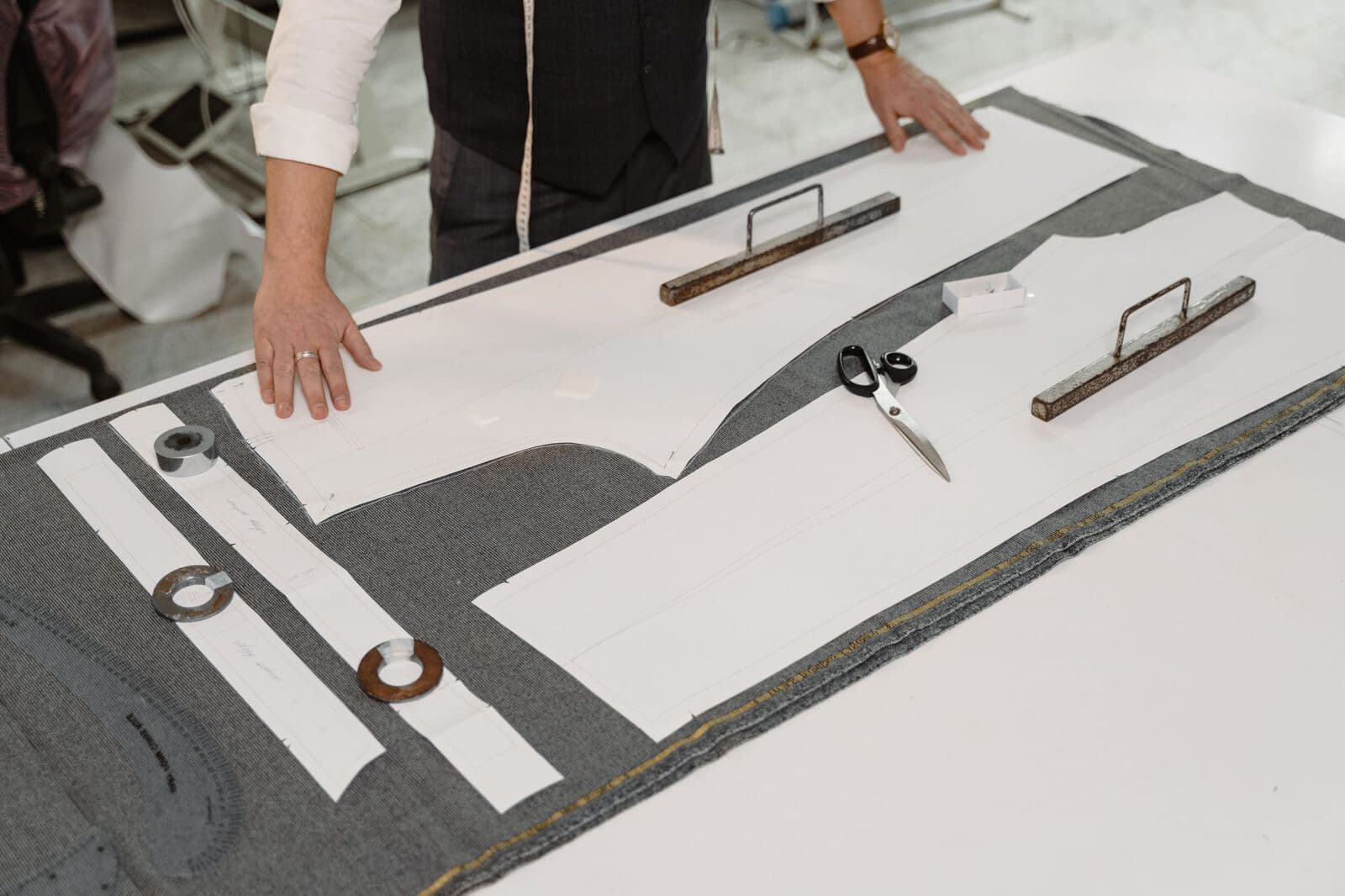
The garment manufacturing process is the sequence of development and production stages that turns a tech pack into packed cartons ready for export: sampling, fabric sourcing and processing, fabric inspection, cutting, sewing, embellishment and washing, finishing, final inspection, packing and shipment. Each stage produces an output the next stage depends on, so a delay or quality gap early in the chain almost always surfaces later as a late ship date or a failed inspection.
This guide walks through each stage as it typically runs in Bangladeshi knit and woven factories, what the buyer should approve at each point and which checks catch problems while they are still cheap to fix. Durations are indicative; the confirmed schedule comes with the quotation and the factory's time-and-action plan.
Key takeaways
- The garment manufacturing process runs in a fixed order: tech pack, sampling, fabric sourcing and processing, fabric inspection, cutting, sewing, embellishment and washing, finishing, inspection, packing and shipment.
- Most delays start before cutting: incomplete tech packs, slow sample comments and fabric lead times usually decide the ship date more than sewing speed does.
- Approve a pre-production (PP) sample made in bulk fabric and trims before cutting; it becomes the reference the whole order is inspected against.
- Finished fabric is commonly graded with the 4-point system before cutting, and the buyer sets the acceptance limit in points per 100 square yards.
- For a new style, the full cycle from tech pack to shipment often takes roughly three to five months, depending on fabric, factory capacity and approvals; the quotation confirms the schedule.
The garment manufacturing process at a glance
Every bulk order moves through the same core stages, whether the product is a jersey T-shirt or a woven shirt. The table summarizes what each stage produces and the checks buyers and factories commonly use to control it.
| Stage | Main output | Typical checks |
|---|---|---|
| Tech pack and costing | Agreed specification and quotation | Completeness of measurements, bill of materials, construction and artwork; fabric and trim availability |
| Sampling | Approved proto, fit, size set and PP samples | Measurements against spec, fit on a model or form, fabric and trim match, workmanship |
| Fabric sourcing, knitting or weaving | Greige fabric to specification | Yarn count, fabric construction, GSM, width, greige defects |
| Dyeing and finishing | Finished fabric in approved shades | Lab dip and shade approval, shrinkage, colorfastness, GSM after finishing |
| Fabric inspection | Released rolls, sorted by shade | 4-point defect grading, shade bands, width and weight checks |
| Cutting | Numbered, bundled cut panels | Marker consumption, ply alignment, panel accuracy against patterns |
| Sewing | Assembled garments | Inline inspection, end-of-line inspection, measurement checks |
| Printing, embroidery and washing | Decorated or washed panels or garments | Placement, color match, hand feel, shade and measurements after washing |
| Finishing and pressing | Trimmed, pressed and tagged garments | Thread ends, pressing quality, label and tag accuracy, needle detection where required |
| Final inspection | Inspection report and release decision | AQL-based sampling, measurements, function and packing checks |
| Packing and shipment | Sealed cartons and shipping documents | Carton marks, assortment, carton dimensions and weight, document accuracy |
Tech pack and the sampling sequence
Sampling is where the buyer and the factory agree what a correct garment looks like before bulk fabric is cut. Most programs move through the stages below; simple repeat styles may skip some, while new fits often need extra rounds.
- 01
Tech pack review
Before quoting, the factory and our sourcing team check the tech pack for gaps: flat sketches, a graded measurement chart with tolerances, the bill of materials (fabric, trims, labels, packaging), stitch and seam types, artwork with placement and dimensions, and colorways. Missing information at this point turns into an assumption later, so questions are raised in writing. Our garment sourcing guide explains how this fits into supplier selection.
- 02
Proto sample
The first physical version of the design, often in substitute fabric. It confirms silhouette, construction and proportions, not final color or hand feel.
- 03
Fit sample
Made in the base size, ideally in the actual fabric or a close substitute, and reviewed on a fit model or form. Comments go back as marked-up measurement and pattern corrections; complex fits can take two or three rounds.
- 04
Salesman or photo samples (optional)
Small quantities for line reviews or e-commerce photography, made once the design is close to final.
- 05
Size set
One sample in each size, or a selection across the range, to confirm grading. Grading errors that pass this stage tend to reappear as measurement failures at final inspection.
- 06
Pre-production (PP) sample
Made with bulk fabric, bulk trims and approved labels, ideally by the line that will run the order. The approved PP sample, together with any written comments, becomes the reference for inline and final inspection. Cutting should not start without it.
- 07
Top of production (TOP) sample
Pulled from the first garments off the line to confirm that bulk matches the approved PP sample. Some buyers also request shipment samples from packed cartons.
Fabric sourcing, knitting, weaving, dyeing and finishing
Fabric usually sets the critical path, because it must be made, dyed and finished before cutting can start. In Bangladesh, many knit factories knit and dye in-house or through nearby mills, while a significant share of woven fabric is imported, which tends to add time to woven programs.
- Yarn and fabric specification
- Fiber content, yarn count, construction (for example single jersey, rib, interlock, fleece, twill or poplin), weight in GSM or ounces per square yard, and finished width are fixed in the tech pack or a fabric sheet. Our fabric guide explains the main constructions.
- Knitting
- Circular knitting machines produce jersey, rib, interlock and fleece; flat knitting machines produce sweaters, collars and cuffs. Machine gauge and stitch length control the fabric's weight and dimensional stability.
- Weaving
- Looms interlace warp and weft yarns into fabrics such as poplin, twill, oxford and denim. Yarn-dyed checks and stripes are dyed before weaving, so color decisions are needed earlier.
- Greige inspection
- Unfinished (greige) fabric is checked for knitting or weaving faults before dyeing, while defects are easy to trace.
- Lab dips and strike-offs
- Lab dips are small dyed swatches submitted for approval against the buyer's color standard under an agreed light source; strike-offs do the same for prints. Approving both early keeps bulk dyeing on schedule.
- Dyeing
- Knit fabric is most often piece dyed in jet or soft-flow machines; woven fabric may be piece dyed, yarn dyed or garment dyed. Shade consistency between dye lots is managed with shade bands approved by the buyer.
- Finishing
- Mechanical and chemical finishing set hand feel and stability: compacting and stentering for knits, sanforizing for many wovens, plus optional brushing, peaching, softening or enzyme treatments. Shrinkage and colorfastness tests on bulk fabric confirm the result before cutting.
Fabric inspection with the 4-point system
Before cutting, finished fabric is commonly graded with the 4-point system, described in ASTM D5430, which assigns penalty points to each visible defect according to its size. The roll or lot score is expressed per 100 square yards: total points × 3,600 ÷ (yards inspected × cuttable width in inches).
The buyer sets both the sample size and the acceptance limit. Inspecting around 10% of rolls and a limit of about 40 points per 100 square yards are common starting points for apparel fabric, but neither is universal; agree them in the purchase order.
| Defect size (length or diameter) | Penalty points |
|---|---|
| Up to 3 inches | 1 |
| Over 3 and up to 6 inches | 2 |
| Over 6 and up to 9 inches | 3 |
| Over 9 inches | 4 |
| Holes and openings of 1 inch or less | 2 |
| Holes and openings over 1 inch | 4 |
Cutting: marker making, spreading and cutting
The cutting room converts approved fabric into accurate panels, and it is where most fabric cost is won or lost.
- 01
Pattern and marker making
Approved production patterns are digitized and graded in CAD, then nested into a marker: the layout of all pattern pieces for a size ratio across the usable fabric width. Marker efficiency drives fabric consumption, which is why consumption should be reconfirmed against the actual bulk fabric width.
- 02
Spreading
Fabric is laid in plies to the marker length, by hand or with a spreading machine. Knits are usually relaxed before spreading and laid without tension so they are not stretched. Fabrics with nap, one-way prints or directional shading are spread in one direction, and rolls from different shade lots are kept apart.
- 03
Cutting
Straight-knife and band-knife cutting are common, and many larger factories also use computer-controlled automatic cutters. Notches and drill marks are transferred so that sewing operators can align pieces accurately.
- 04
Numbering, bundling and fusing
Panels are numbered by ply so that pieces from the same ply are sewn together, which prevents shade differences within one garment. Interlinings are fused where specified, and bundles move to printing or embroidery, or straight to the sewing line.
- 05
Cut panel audit
Random panels are checked against the patterns before leaving the cutting room, when a mis-cut costs a panel rather than a garment.
Sewing, printing, embroidery and washing
Sewing assembles the garment through a planned sequence of operations, each assigned to an operator and a machine. The factory's industrial engineering team breaks the style into operations (for a basic T-shirt: shoulder join, neck rib attach, sleeve attach, side seams, hemming and label attach) and sets a standard minute value (SMV) for each. Line balancing then distributes operations so that no single workstation becomes a bottleneck. Knits rely mainly on overlock, flatlock and coverstitch machines; wovens add lockstitch, bartack and buttonhole machines.
Quality on the line is controlled by inline inspection, where quality staff check operations during sewing, and by end-of-line inspection of finished garments. A problem found inline can be corrected on the next bundle; the same problem found at final inspection usually means rework and delay.
Printing and embroidery are often applied to cut panels before sewing, which gives flat, accurate placement, although designs that cross seams must be applied to finished garments. Screen printing suits larger quantities with a limited number of colors, direct-to-garment (DTG) printing suits detailed artwork on cotton, sublimation works on light-colored polyester, and heat transfers suit small graphics and tagless labels. Embroidery runs on multi-head machines from digitized files.
Washing (enzyme, softener, stone or pigment and garment dyeing) is applied to finished garments for denim, casualwear and vintage looks. Washing changes measurements, shade and hand feel, so wash tests on the PP sample and measurement checks after washing are essential.
Finishing, inspection, packing and shipment
The last stages turn sewn garments into export-ready cartons, and many avoidable claims originate here.
- 01
Trimming and finishing
Loose threads are trimmed, spots are cleaned, and hang tags and price tickets are attached as specified.
- 02
Pressing
Steam pressing or tunnel finishing sets the final appearance. Pressing instructions matter for prints and some synthetics, which can glaze or mark under heat.
- 03
Needle detection
Many buyers, particularly for children's wear, require every garment to pass a needle detector, supported by a broken-needle control policy on the sewing floor.
- 04
Internal and final inspection
The factory's quality team audits finished goods first. A final random inspection is then commonly carried out by the buyer, its agent or a third party using AQL sampling based on ISO 2859-1. Our garment quality control guide covers AQL levels and defect classification.
- 05
Packing
Garments are folded, bagged and packed in solid or ratio assortments according to the buyer's packing instructions. Carton marks, dimensions and gross weights are checked against the packing list.
- 06
Shipment
The factory or the buyer's forwarder books space, export documents are prepared, and cartons are stuffed into containers at the factory or a depot. Shipping terms and documents are explained in our guide to importing clothing from Bangladesh.
How long each stage typically takes
Stages overlap, and the critical path is usually fabric and approvals rather than sewing. The ranges below are indicative for a new style made in Bangladesh and assume prompt buyer feedback; repeat orders on available fabric can be considerably shorter.
| Stage | Indicative duration | Main variables |
|---|---|---|
| Tech pack review and quotation | About 1–2 weeks | Completeness of the tech pack, number of styles, fabric enquiries |
| Proto and fit sampling | Roughly 1–3 weeks per round | Sample fabric availability, number of fit rounds, courier time |
| Lab dips and strike-offs | Roughly 1–2 weeks per submission | Color difficulty, number of resubmissions |
| Size set and PP sample | Roughly 1–3 weeks | Readiness of bulk fabric and trims, speed of approval |
| Bulk fabric, locally knitted | Often 2–5 weeks | Yarn availability, dyeing capacity, special finishes |
| Bulk fabric, imported woven | Often 4–8 weeks or more | Mill lead time, inbound shipping and clearance into Bangladesh |
| Cutting, sewing and finishing | Often 2–5 weeks | Order quantity, style complexity, line allocation, embellishment and washing |
| Final inspection and packing | A few days to about 1 week | Inspection booking, rework if needed |
Where production delays usually start
Most late shipments trace back to the first half of the process, not the sewing floor: incomplete tech packs, slow fit comments, unapproved lab dips and late trim orders all compress production time. Three habits help: send a complete tech pack with a graded measurement chart, agree a written time-and-action plan with approval deadlines for both sides, and order long-lead trims in parallel with sampling. Our production management team tracks these milestones with partner factories and reports exceptions early. When your tech pack is ready, request a quote.
Frequently asked questions
What are the main stages of the garment manufacturing process?
The core stages are tech pack and costing, sampling, fabric sourcing and knitting or weaving, dyeing and finishing, fabric inspection, cutting, sewing, printing, embroidery or washing, finishing and pressing, final inspection, packing and shipment. Several stages overlap; for example, bulk fabric is often produced while the size set and PP sample are being approved.
What is the difference between a PP sample and a TOP sample?
A PP (pre-production) sample is made before bulk cutting, using bulk fabric and trims, and once approved it becomes the reference for the order. A TOP (top of production) sample is taken from the first garments produced on the line to confirm that bulk production matches the approved PP sample.
How long does garment manufacturing take from tech pack to shipment?
For a new style, the full cycle often takes roughly three to five months including sampling, but it varies widely with fabric source, number of sample rounds, order size and factory capacity. Repeat styles on available fabric can be considerably faster. The confirmed schedule comes with the quotation and time-and-action plan.
What is the 4-point system in fabric inspection?
It is a method of grading fabric by assigning 1 to 4 penalty points to each defect according to its size, then calculating points per 100 square yards. The buyer sets the acceptance limit; rolls or lots above it are rejected, replaced or cut around, depending on what was agreed.
Sources and references
- ASTM D5430: Standard Test Methods for Visually Inspecting and Grading Fabrics, ASTM International (Describes the 4-point fabric grading system.)
- ISO 2859-1: Sampling procedures for inspection by attributes, International Organization for Standardization (ISO) (Basis for the AQL sampling plans used in final inspection.)
- Test methods for colorfastness and dimensional change, AATCC (Association of Textile, Apparel & Materials Professionals)
- Bangladesh Garment Manufacturers and Exporters Association, BGMEA (Industry body for Bangladesh's garment exporters.)
Regulations, tariffs and preference schemes change. Always confirm current requirements with the official source or a licensed customs broker.