Products · Blouses
Blouse Manufacturer in Bangladesh for Women's Woven Tops
We source blouses and woven tops for womenswear labels, fashion retailers and online brands. Our sourcing team works with vetted partner factories in Bangladesh that handle fluid fabrics, prints and detailed finishing, and we manage sampling, production follow-up and inspection.
Blouses are a different discipline from structured shirts. The fabrics are softer and slippery, details such as gathers, ruffles and ties are common, and prints are often central to the design. Factories need careful cutting, fine needles and seam finishes suited to light fabrics. This page covers how common blouse fabrics behave, the design details to specify, print development and the tests that matter most.
Blouses depend on fabric behavior and careful handling
Blouse quality depends on how the factory handles soft, fluid fabrics through cutting, sewing and pressing. Viscose, crepe, georgette and satin shift during spreading and can pucker, slip or show needle marks if machines are not set up for them.
When we shortlist factories for blouses, we look for experience with light wovens, appropriate needle and thread sizes, seam finishes such as French seams and narrow rolled hems, and pressing that does not leave shine or marks. We also check how the factory handles sheer fabrics, where seam allowances show through and need neat finishing.
Prints and embroidery often carry the design, so we also review the print partners and embroidery units the factory uses.
Blouse fabrics and how they behave in production
| Fabric | Fiber | Drape and feel | Production watch-outs |
|---|---|---|---|
| Viscose challis | Viscose (rayon) | Soft, fluid, matte | Shrinks and can slip at seams; test before cutting |
| Crepe | Polyester or viscose | Grainy texture, good drape | Can be springy; needs stable cutting |
| Georgette | Polyester or silk-like synthetics | Sheer, light, slightly crinkled | Seams show through; use neat narrow finishes |
| Chiffon | Polyester | Very sheer and light | Difficult to cut and hem; often lined |
| Satin and charmeuse | Polyester or viscose blends | Lustrous face, slippery | Shows needle marks and pressing shine |
| Cotton voile and lawn | Cotton | Light, crisp, breathable | Can be sheer in light colors |
| Lyocell or modal blends | Cellulosic fibers | Smooth, soft drape | Check shrinkage and abrasion marks |
Design details to specify clearly
- Gathers and shirring
- State gather ratio and, for shirring, elastic thread type and rows; shirring changes measurements significantly.
- Ruffles and frills
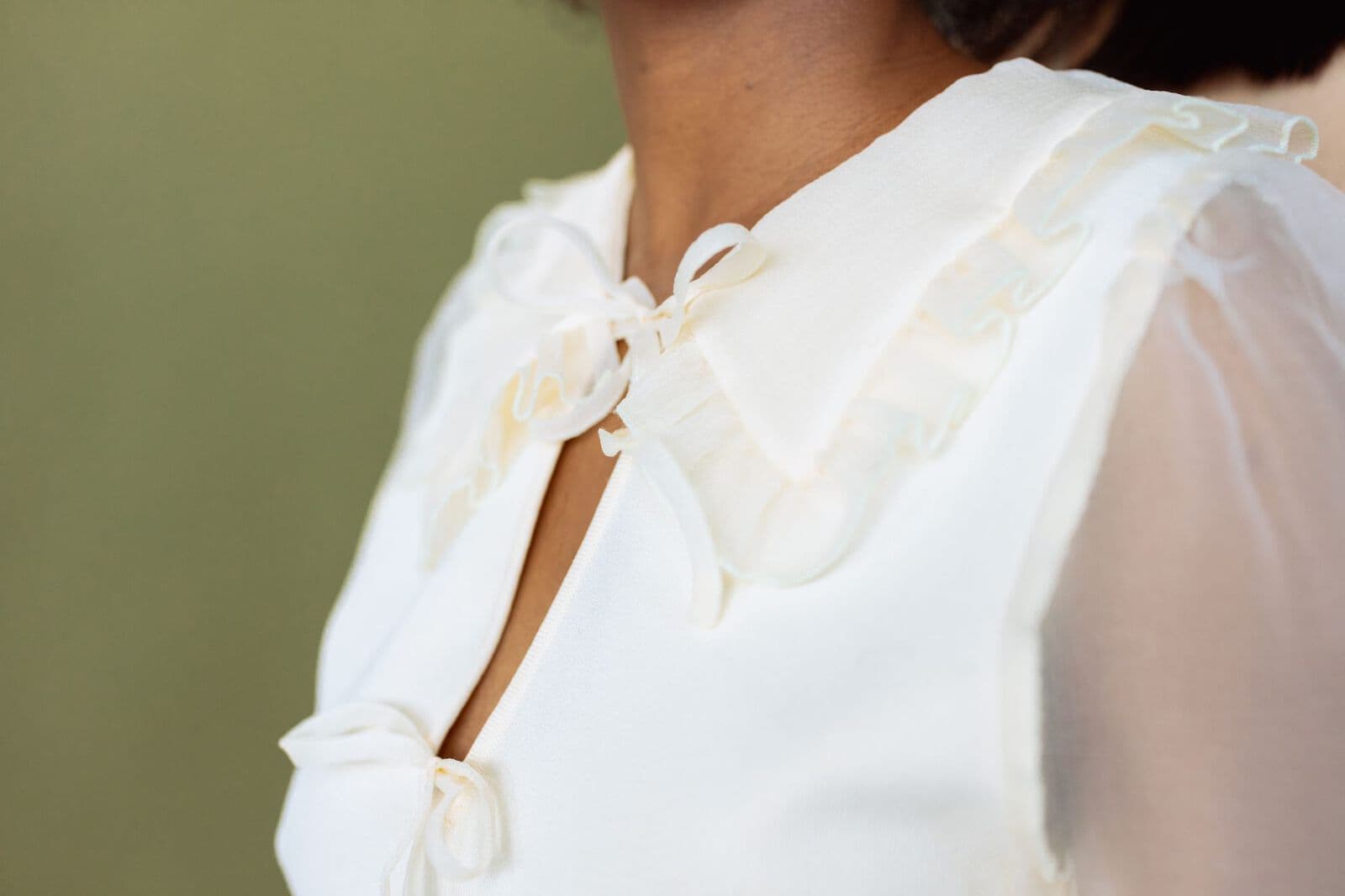
- Specify width, finish (rolled hem or picot) and whether cut on the bias or straight grain.
- Pintucks and pleats
- Give tuck width and spacing; these add fabric consumption and sewing time.
- Embroidery and lace
- Schiffli embroidery, broderie anglaise or lace insertion, with placement on the pattern piece.
- Ties, bows and closures
- Neck ties, button loops, covered buttons or hidden snaps, each with its own sourcing time.
- Sleeves
- Puff, balloon, flutter or bishop sleeves, with cuff or elastic finish and sleeve head volume.
Test viscose for shrinkage and seam slippage
Viscose is popular for blouses but can shrink noticeably and its seams can pull apart under strain. Ask for dimensional stability and seam slippage tests on bulk fabric, set seam allowances that suit the fabric, and confirm care instructions with wash tests on PP samples.
Print development for blouses
- 01
Artwork and repeat
Provide print files with repeat size, colorways and scale on the body.
- 02
Strike-off
The printer produces a sample on the actual fabric, using digital or rotary screen printing.
- 03
Color approval
Approve each colorway against your standard under agreed lighting.
- 04
Placement
For engineered or placement prints, confirm position on each pattern piece and size.
- 05
Bulk print and testing
Bulk fabric is printed and tested for colorfastness to washing, rubbing and light before cutting.
Frequently asked questions
What is the MOQ for printed blouses?
Print minimums often set the MOQ. Rotary screen printing usually needs higher quantities per design and colorway, while digital printing can allow smaller runs at a higher unit cost. The factory's garment minimum applies too. We confirm the MOQ in the quotation.
Can factories handle sheer and slippery fabrics?
Yes, selected partner factories regularly work with georgette, chiffon and satin. We review their seam finishes and pressing on samples before recommending them for bulk.
Can you source lower-impact viscose?
Yes. Some mills offer viscose made from certified wood sources or with traceability documentation. Claims should be supported by certificates and supply-chain records; see our sustainable textiles guide.
How are women's sizes graded?
The factory grades from your base size using your size chart and grade rules. If you do not have grade rules, we can work with the factory to propose them for your review, then check them in the size set.
How long does a blouse order take?
Sampling usually takes two to four weeks per round, plus time for print strike-offs. Bulk blouse production commonly runs seven to eleven weeks after PP approval. The schedule is confirmed in the quotation.
Related products
Services for this category
Buyer guides
Develop your blouse collection
Share sketches, tech packs or reference tops with fabric, print and detail notes and quantities per colorway. We will match partner factories experienced with fluid fabrics and propose a sampling plan.